
















































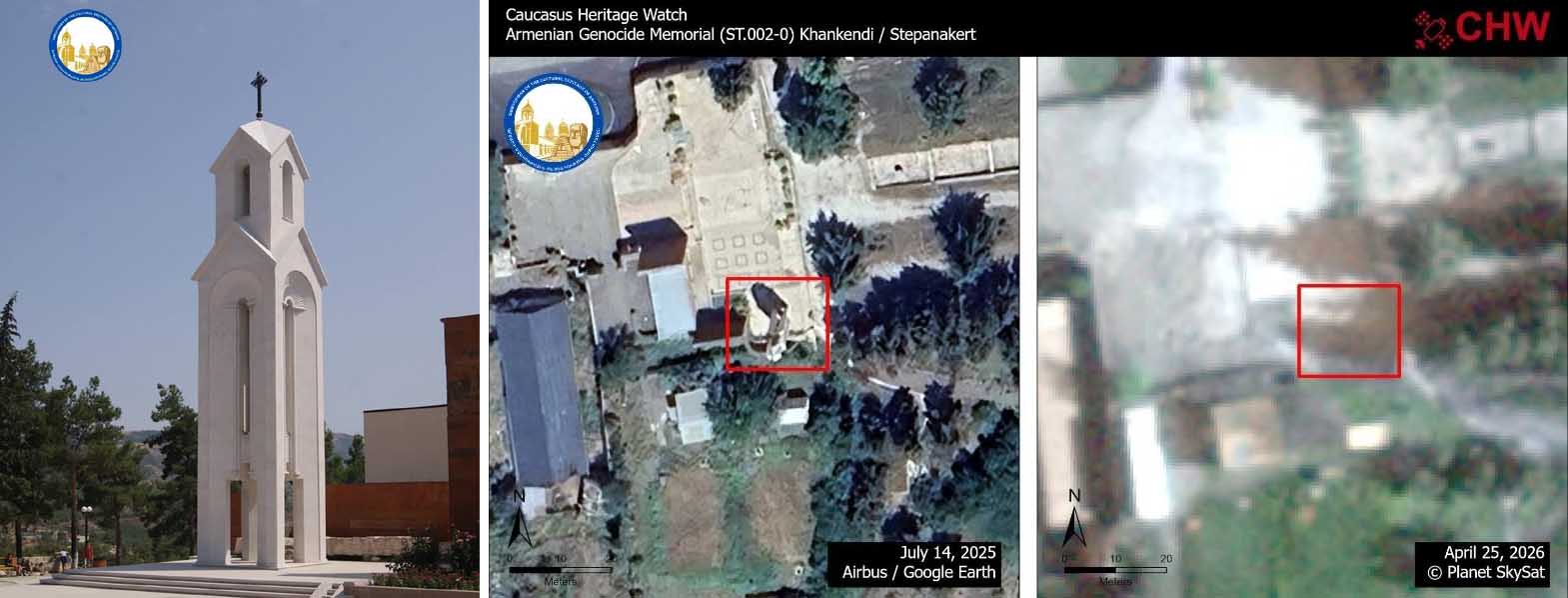
The documentation provided by Caucasus Heritage Watch (CHW) records yet another compelling piece of evidence regarding the policy aimed at the systematic destruction of Armenian historical and cultural heritage. The complete eradication of the memorial dedicated to the Centennial of the Armenian Genocide, located within the Stepanakert Memorial Complex, cannot be interpreted as an isolated incident; it clearly aligns with a broader process of systematic destruction of cultural heritage and the erasure of historical memory.
The white marble bell tower, which housed an ossuary containing human remains brought from Deir ez-Zor, held profound symbolic significance. In Armenian collective memory, Deir ez-Zor is not merely a geographic place name but a symbol embodying the tragic peak of the Genocide, the site where hundreds of thousands of Armenians were subjected to massacres, forced deportations, and death marches. The destruction of such a monument signifies not only the loss of material value but also a direct blow to historical memory, the remembrance of the victims, and the identity of their descendants.
Satellite data from Airbus and Planet Labs clearly document that the monument and the entire adjacent memorial complex were destroyed between July 14, 2025, and April 25, 2026. This chronological data attests not to accidental damage, but to a deliberate and phased operation aimed at the total cleansing of the area of any traces of Armenian presence.
This action must be viewed within the context of international law and the protection of cultural heritage. The intentional destruction of cultural values violates several international conventions, including documents adopted under the auspices of UNESCO. However, this case demonstrates that such actions persist, often in an environment of impunity, which encourages their repetition.
Moreover, the destruction of the monument bears a clear political and ideological character, beyond its cultural implications. It aims to reshape the historical narrative of the territory by erasing evidence of Armenian presence and creating a blank historical space. This is a classic example of cultural genocide, where not only are people destroyed, but also their memory, culture, and the material evidence of their existence.
Read also


Thus, the destruction of the Bell Tower dedicated to the 100th anniversary of the Armenian Genocide in Stepanakert must be assessed not as a single act, but as an integral part of a continuous and systematic policy intended to eliminate Armenian historical and cultural heritage and distort historical memory. This reality demands not only scholarly documentation but also a clear and practical response from the international community.
Hovik Avanesov, Cultural Heritage Ombudsman of Artsakh, Vice President of the Azgayin (National) Cultural-Historical NGO
Ombudsman of the Cultural Heritage of Artsakh