


























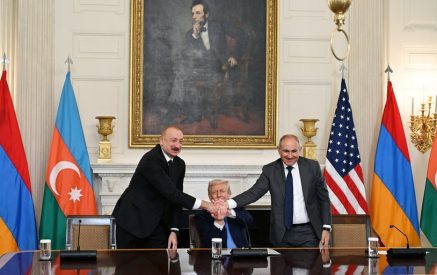

Nikol Pashinyan has presented the Armenian public with a “vision” of Armenian-Azerbaijani peace that, according to him, will follow the signing and ratification of the peace treaty. The basis for Pashinyan’s description is the “initial impression” he claims to have formed from his interactions with Azerbaijani President Ilham Aliyev in Turkmenistan. According to Pashinyan, such peace would mean a situation free of any mutual claims and any enclaves or exclaves.
Pashinyan has offered no details about the nature of those interactions. For instance, could they have taken place over dinner, when the heads of CIS member states might also have been a little tipsy? In that case, perhaps Ilham Aliyev raised a toast to peace in the spirit of “Caucasian eloquence,” and that became the basis for Pashinyan’s “initial impression.” After all, when we look, for example, at the Azerbaijani president’s sober speeches in recent years, it is simply impossible to derive from them any impression that Azerbaijan is inclined toward a peace that entails “no demands” on Armenia—whether that impression is initial or intermediate.
But perhaps the real issue here is something else. Pashinyan seems to have begun addressing the Armenian-Azerbaijani peace treaty with considerable consistency. This means that he either feels pressure on this issue or senses the risk of tensions if he delays, or he has simply launched a campaign for a referendum on a new Constitution. The “rosy” picture of peace that Pashinyan presented the other day is part of that campaign. First, this picture will presumably be promoted consistently; then it will likely be followed by “blackmail”: anyone opposed to adopting a new Constitution is, therefore, opposed to peace.
It is a familiar model, but Pashinyan essentially has no opportunity to be more “creative,” and apparently not much time either. He will therefore probably resort to a tried-and-tested approach. Of course, that approach did not help him retain a constitutional supermajority, which may well have caused discontent and raised doubts in Baku. Now, on the one hand, Pashinyan is busy doing his “homework” to dispel those doubts, and that also involves campaigning. There is no formal legal process underway yet, of course, but Pashinyan faces a very difficult task: convincing the public that a new Constitution is not an Azerbaijani demand but a domestic necessity for Armenia.
Read also
That will be extremely difficult, because Azerbaijan has made its demand far too openly and explicitly. Consequently, from a purely legal standpoint, the time allocated to campaigning will be nowhere near enough for Pashinyan to convince Armenia’s reasonable citizens that they will be going to the polls for Armenia, not for Azerbaijan. And there is certainly no shortage of reasonable citizens in Armenia.
Hakob BADALYAN