



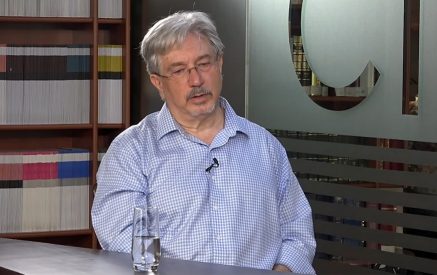






















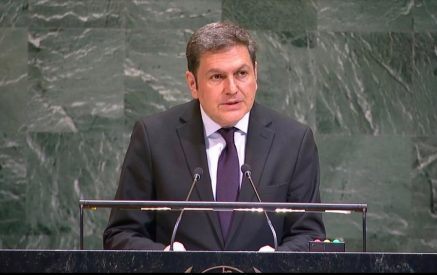






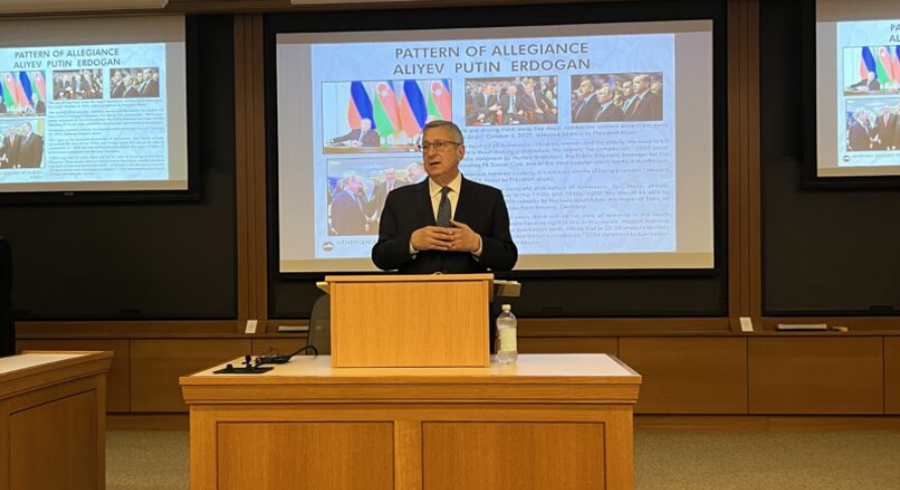
Mirrorspectator. CAMBRIDGE, Mass. — Attorney and professor Van Z. Krikorian delivered a wide-ranging talk at Harvard Law School on April 17 as the guest of the Harvard Armenian Law Students Association on human rights law as it relates to the Armenian Genocide and the ethnic cleansing of Artsakh to a mixed audience of Harvard students and community members.
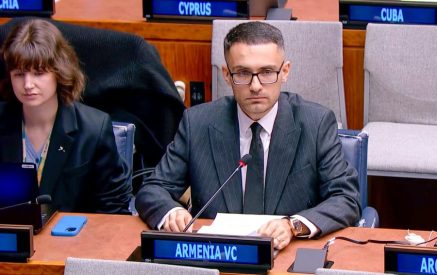
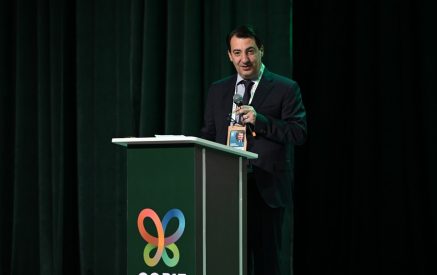
Co-President Anahit A. Melkonyan of the Harvard Armenian Law Students Association introduced Krikorian, noting his extensive knowledge in the field of human rights and international law. He is an adjunct professor at Pace Law School, attorney and Chair and CEO of Global Gold Corporation. Krikorian served as Armenia’s Deputy Representative and Counselor at the United Nations in 1992 and on the Turkish-Armenian Reconciliation Commission from 2001 to 2004. He has served as chair of the Armenian Assembly of America (of which he is now chair emeritus) as well as of the Armenian National Institute, and was awarded Armenia’s Medal of Honor in 2017. Krikorian has testified before Congress on numerous occasions and has spent decades advocating on human rights issues, including authoring key provisions of the Freedom Support Act and the Foreign Assistance Act.
Krikorian began with a powerful quote from the famous 19th century French novelist Victor Hugo, who declared “If a man has his throat cut in Paris, it’s a murder. If 50,000 people are murdered in the East, it is a question.” Krikorian commented that this is appreciated by human rights victims because what happens in the aftermath of atrocities is denial, and this is what has happened for the most part to the Armenians.
He posed the question of how law might play a role in stopping atrocities and genocide, especially when multiple reports show more than 15 genocides occurred even after the UN adopted the Genocide Convention in 1948, and crimes against humanity began to be defined internationally decades earlier than that.
Read also
Krikorian pointed out that the problem is that international systems have been designed to work with democracies but they don’t work when matched with authoritarian regimes. Azerbaijan, with over 300 political prisoners and many other types of human rights violations, is recognized as a dictatorship by many international human rights organizations. As an example, he cited Freedom House, which ranked Azerbaijan in global freedom with six out of a possible 100 points.
He suggested that just as in international trade law, multilateral as opposed to global arrangements could be reached on how to resolve disputes. In other words, countries that really believe what they’re saying in terms of human rights commitments and the rule of law need to come up with a system for themselves with a mechanism to deal with bad actors, Krikorian said, since what we have today is not working.
Aram Arkun
Read more at the source