




















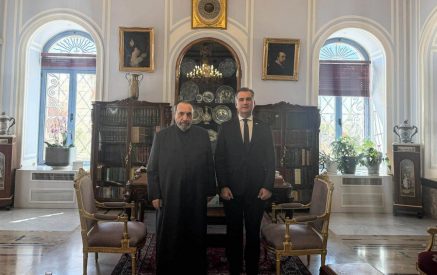













Geghard. Among the various Jewish ethnic subgroups residing in the Republic of Azerbaijan, including Ashkenazim, Sephardim, Mizrahim, Mountain Jews, and Georgian Jews, the Sephardic community is of particular interest. Its leader is Rabbi Zamir Isayev, who can be characterized as the “special envoy” of the Azerbijani president to Israel and the United States. Isayev frequently visits both countries, primarily to represent Baku’s interests.
Despite the wide range of allegations made against Isayev, including descriptions of him as a “corrupt provocateur who carries out the criminal directives of Baku’s dictator Aliyev II,” as well as accusations of bribery, fraud, and misappropriating state funds and donations through organizations with no followers, his role in Azerbaijan’s domestic politics, and particularly in its foreign relations, is nevertheless evident.
Azerbaijani authorities are satisfied with the services rendered by this figure, who has described Azerbaijan as “the safest place” for the Jewish people. In Baku, he is particularly praised for promoting the so-called “Azerbaijani truth, the country’s multicultural values, and its rich cultural heritage to the international community, as well as for contributing to the strengthening of unity among Azerbaijanis.” Various Jewish organizations likewise value highly Isayev’s role, particularly with respect to Jewish communal life in Azerbaijan and in Israel–Azerbaijan relations.
Israeli authorities emphasize Isayev’s role not only in the development of strategic relations with Azerbaijan, but also in efforts aimed at involving Azerbaijan in the “Abraham Accords.”
Read also
Zamir Isayev is also involved in supporting the Aliyev administration during nationwide elections in Azerbaijan. Using his position as a community leader, he influences the Jewish community to vote for Aliyev during presidential elections. He consistently praises Ilham Aliyev, highlighting his attitude toward the Jewish community and emphasizing the fact that Jewish communities in the country are financed through the Azerbaijani president’s reserve fund.
Zamir Isayev is also the leader of the Georgian Jewish community, the director of the Jewish school in Baku, the deputy director of the Azerbaijani branch of the Jewish humanitarian organization “European Route of Jewish Heritage,” the representative of the Azerbaijani branch of the American Jewish Aid Organization, the deputy head of the Azerbaijani branch of the Jewish organization “Vaad Le-Hatzala,” and the coordinator in Baku of “Vaad L’Hatzolas Nidchei Yisroel,” which is based in New York and has offices in Tbilisi and Baku.
In 2024, Zamir Isayev also became one of the 150 members of the “World Jewish Council,” chaired by Israeli President Isaac Herzog, thereby taking on a mission to combat antisemitism and promote positive dialogue about Jews.
During the international climate conference (COP29) held in Baku in 2024, Isayev also led a gathering of Jewish community leaders from various countries and introduced the guests to the Jewish communities of Baku and the Quba region. On the basis of this meeting, and under his initiative and leadership, an annual conference of religious leaders was established. At the second such conference held in Baku in 2025, Isayev once again praised the Azerbaijani authorities and President Aliyev personally, highlighting Azerbaijan’s “internationally recognized status as a tolerant, multicultural country with interfaith harmony.”
The leader of the Jewish community has also been engaged in anti-Armenian activities. He accused Armenians of killing nearly 3,000 Mountain Jews and around 50,000 Azerbaijanis during the period of 1918–1920. “Israel is my country as a Jew. Azerbaijan is my country as an Azeri,” said Isayev, who was born in Baku, raised in Israel, and served in the Israeli military.
Following the occupation of Artsakh, Isayev visited the region and expressed pride that members of his community had also participated in the war. His tour of the area along the Araks River can be considered not only as anti-Armenian but also as anti-Iranian, given his broader activities in both directions. Moreover, as part of his anti-Armenian and anti-Iranian agenda, Isayev has sought to engage and mobilize not only other Jewish communities in Azerbaijan and his rabbinical colleagues in Israel, the United States, Europe, and other regions, but also Jewish or pro-Israel politicians and organizations in support of these efforts.
On various occasions, Isayev has also commented on what he describes as the “destruction committed by Armenians” in the territories that remained under Armenian control after 1993. He has focused particular attention on the so-called “Khojaly events,” organizing events and authoring articles that compare those events to the October 7, 2023, attack on Israel by Hamas militants. Echoing Baku’s official anti-Armenian rhetoric, Isayev has also accused the Armenian side of refusing to provide maps of minefields and has called on the international community to hold Armenia accountable.
Zamir Isayev was also seen among the group of fake “environmental activists” who, beginning in December 2022, blocked the Berdzor corridor—the only road connecting Artsakh with the Republic of Armenia—blockading more than 120,000 Armenians.
Isayev continued to justify Aliyev’s military operations against Artsakh following Azerbaijan’s large-scale offensive in September 2023. On October 6, the leader of Azerbaijan’s Jewish community called on the Jews of Armenia to leave the country—stating, “Leave before it is too late”—and even offered his assistance. He justified his appeal by claiming that Armenians had accused Israel of supporting Azerbaijan’s policy of ethnic cleansing against the Armenians of Artsakh and that these accusations had led to the attack on the synagogue in Yerevan in the autumn of 2023. Commenting on the incident, the rabbi remarked that the synagogue in Azerbaijan’s Oghuz district remains open even at night, adding that Armenia had something to learn from Azerbaijan in this regard.
“Deeply concerned” about the fate of the Jewish synagogue operating in Yerevan and the Jews living in Armenia, Isayev later admitted that, until the autumn of 2023, Jews in Azerbaijan had had no information about or contact with the Jewish community in Armenia.
Isayev, who hung the portrait of Ilham Aliyev in his office, also angrily reacted to the U.S. State Department’s decision to include Azerbaijan among countries mentioned for violations of religious freedom. He argued that Washington was attempting to damage Azerbaijan’s international reputation and claimed that the move was driven by the Armenian lobby, speaking on behalf of Azerbaijani and American Jewish communities.
Zamir Isayev has also focused his attention on the activities of the mayor of New York City. On April 24, 2026, marking the 111th anniversary of the Armenian Genocide, Zohran Mamdani posted on social media, referring to the memory of 1.5 million Armenians killed by the Ottoman Empire in the territories of present-day Turkey, Syria, and Armenia. In his message, the mayor also addressed the 2020 Azerbaijani and Turkish offensive against Artsakh, as well as the forced displacement of more than 100,000 Armenians from Artsakh in 2023, emphasizing that Azerbaijan and Turkey continue the genocidal campaign that began more than a century ago.
Joining official statements from Baku as well as those of so-called non-governmental organizations, the leader of the Jewish community described the New York mayor’s remarks as “false, provocative, and harmful to peace”.
Certainly, for Isayev anti-Armenian sentiment appears to be a primary factor; however, it can also be argued that his stance toward the Mayor of New York is linked to other considerations as well. Zohran Mamdani, who is of Indian origin and practices Islam, has repeatedly condemned Israel’s actions against Palestinians in Gaza.
In his public speeches, Isayev has framed his mission as strengthening an “existential connection” between Azerbaijan, Israel, and the United States. In his interactions with U.S. Jewish communities, the leader of Azerbaijan’s Sephardic Jewish community has emphasized Washington’s support for Azerbaijan in defending itself against external threats, and has urged efforts to “bring congressional members with anti-Azerbaijani positions into our fold,” aiming to soften negative attitude toward the country.
He who refers to the Iranian city of Tabriz as “historically Azerbaijani” for Azerbaijanis has also voiced complaints about Iran in various other countries and platforms, describing military exercises along Azerbaijan’s border as a provocation. According to him, Canada and other Western countries should support Azerbaijan against Iran.
Isayev’s anti-Iranian stance can arguably be linked to his involvement in serving Israeli interests, while his anti-Armenian position is driven primarily by a reciprocal relationship with the Azerbaijani authorities and President Aliyev personally. Isayev is involved in important events held in Azerbaijan and holds a significant role, influence, and reputation. In return for promoting anti-Armenian narratives and enhancing the image of Azerbaijan and its president on international platforms, the rabbi is, presumably, well compensated.
Ignoring the fact that he is a cleric, Isayev rather appears to resemble a hired agent of Azerbaijani political and propaganda circles, who also spreads extreme anti-Armenian ideas, displaying behavior unbefitting a member of the clergy.
“GEGHARD” SCIENTIFIC ANALYTICAL FOUNDATION