













Armenianweekly. The parliamentary elections in Armenia, scheduled for June 7, 2026, were set to be a battleground between the ruling Civil Contract party and the opposition. However, the election campaign has turned into a series of public scandals, in which the central figures are not the prime minister’s political opponents, but displaced persons from Artsakh — people who survived the exodus of 2023. An analysis of events over recent months suggests that Nikol Pashinyan’s team has mounted a systematic campaign to stigmatize the people of Artsakh, transforming them from victims of ethnic cleansing into “accomplices to war” and the main obstacle to “peace.”
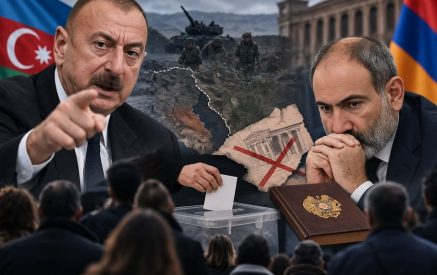
On March 22, 2026, a video filmed in a carriage on the Yerevan metro appeared on social media: the prime minister, speaking in a raised voice and wagging his finger, was telling off a displaced woman from Artsakh who had arrived with her young son. Pashinyan offered the boy a badge bearing a map of Armenia without Artsakh and declared: “Let those who fled not try to say that it was I who surrendered Karabakh.” The woman, who turned out to be the daughter of a fallen soldier from the Karabakh War, replied: “We will not allow ourselves to be deprived of the hope of returning to Artsakh.”
The reaction was immediate. Factions in the Artsakh National Assembly described the prime minister’s remarks as “unacceptable, reprehensible and divisive.” The statement emphasized: “The deliberate insult to the people of Artsakh is not only humiliating, but also grossly distorts reality — we are talking about thousands of people deprived of their homeland under conditions of existential threat and forced displacement.” Under pressure, Pashinyan publicly apologized, but the rhetoric of “Artsakhis as fugitives” had already been unleashed into the public sphere.
Read also
A few days after the incident in the underground, on March 26, at a Cabinet meeting, the prime minister set out the ideological basis for his position: “When we talk about the agenda of return, in essence, we are not allowing these people to find peace and settle down. Peace is not just a treaty; peace is a state in which a person can find peace.” Moreover, he described the hope for return as “imperial policy” and an “anti-Armenian” approach. The right of return, enshrined in international law, has, in Pashinyan’s interpretation, turned into a “status of wanderers,” which to uphold is the “wrong” approach.
The logic here is quite clear: The Civil Contract political program is built on the premise of bringing the Artsakh conflict to an end. Any mention of the right of return undermines this foundation. Consequently, those who raise this issue — the displaced persons themselves — must be discredited.
On May 18, 2026, the prime minister was campaigning in the Arabkir district of Yerevan. He was approached by a local resident, Arpine Sogoyan, a gynecologist and candidate of medical sciences, and the sister of Hrant Papikyan, an officer who went missing during the 44-day war. “You have destroyed the country, you have taken our sons away, you are an enemy of the people,” she declared.
Pashinyan’s reaction was explosive. He burst out shouting, then moved on to direct threats: “You are runaway degenerates, take off your masks, I will break you all and destroy you.” The sons of former presidents and opposition leaders were singled out for particular abuse — they were all labeled “scum who fled the battlefield.” In the heat of the argument, the prime minister snapped at the woman: “Be grateful that they haven’t smashed your head in the nearest toilet.”
A second incident on the same day involved Artur Osipyan, leader of the Artsakh Revolutionary Party. He reminded Pashinyan of the billions in aid provided to Nagorno-Karabakh, noting that the money had gone not to the people but to the authorities. The prime minister responded with accusations of “plunder,” after which he declared: “Let the Karabakh pseudo-elite get out of here,” and Osipyan himself, in his words, “should have died instead of our children.”
It is telling that both incidents on May 18 resulted in repressive consequences for the prime minister’s opponents. According to media reports, Arpine Sogoyan was asked to submit a letter of resignation, while Artur Osipyan was detained by the police on suspicion of hooliganism.
The campaign culminated on May 18 with the appearance on social media and the pro-government website Civic of a video in which several masked men with automatic weapons, against a backdrop of Armenian and Artsakh flags and speaking in the Artsakh dialect, threaten Pashinyan with physical violence: “Nikol, you’ll have to answer for this; we know where you go, which streets you walk down. We’ll finish you off.”
Armenia’s Investigative Committee promptly opened a criminal case regarding death threats linked to the prime minister’s public and political activities. Pashinyan immediately used the video to attack the opposition, stating that the rhetoric of his political opponents “corresponds to the content of the video.”
However, a number of experts and politicians have cast doubt on the authenticity of the recording. Media expert Tigran Kocharyan described the video as a “cheap set-up from the corridors of power,” pointing out that it was pro-government media and bloggers, rather than opposition platforms, who were the first to disseminate the material in an organized manner: “This is an old and tried-and-tested political tactic: create a false threat yourself, spread it yourself, so that you can then assume the role of the victim.”
Arman Tatoyan, the candidate for prime minister from the Wings of Unity party and former ombudsman of Armenia, called for an investigation into “whether this was a provocation and whether it was organized by the authorities, given that they frequently subject Artsakh residents to targeted pressure.” David Ghahramanyan, a photojournalist and internally displaced person from Artsakh, stated outright that the video was “commissioned by Nikol.” Human rights organizations, in a joint statement, described the events as “targeting Artsakh residents and inciting hatred.”
The context gives grounds for skepticism: against the backdrop of a series of real public conflicts between the prime minister and displaced persons, the appearance of such a video seems far too “timely” for the pre-election mobilization of a loyal electorate.
It would be a mistake to view these incidents as spontaneous emotional outbursts. They were preceded by a methodical rhetorical buildup. In particular, there has been deliberate speculation regarding the forced resettlement of Armenians from Artsakh, with the event being portrayed in a derisive and condemnatory light. Thus, the Civil Contract party, led by Pashinyan, seeks to humiliate the displaced persons by labeling the people of Artsakh as “themselves to blame.”
Despite unprecedented pressure, the displaced people are refusing to accept the role of “fugitives” being forced upon them. We managed to obtain comments from Artsakh residents currently living in Vanadzor. Karine Soghoyan, 53, believes that “Pashinyan is simply brazenly accusing my fellow countrymen of things beyond their control. It was Pashinyan who provided no help whatsoever; he did not protect us; he gave treacherous orders; that is precisely why we had to leave our homeland.” Nvard Ukhurnyan, who now works as a taxi driver, emphasizes that “such insults against an entire people must be brought to justice. But of course, with his current allies in the judicial system, that is impossible. I, my family and friends, who left our homes there in Artsakh, will take a different course of action. We know who we will vote for, and it certainly won’t be Nikol; we will fight.”
When asked whether she believed Pashinyan was deliberately targeting the people of Artsakh, Nvard Ukhurnyan replied that “everyone’s ‘beloved’ prime minister knows full well that he has made a number of mistakes. He is a politician, so he will shift the blame and hide his guilt from the people, especially with the elections coming up soon. So I will say that this is indeed the case.”
Thus, the parliamentary elections on June 7 will be a moment of truth for Armenian society, which faces a fundamental choice. Pashinyan’s campaign has laid bare a tectonic fault line: on the one hand, a pragmatic “peace” at the cost of renouncing the right of return and collective memory; on the other, solidarity with those who have lost their homeland and refuse to accept that loss as final. The question is not merely who will win the election, but whether Armenian society will be able to preserve the moral foundations of its national identity, or whether it will choose to forget those whom the country’s leader publicly refers to as “defectors.”
Davo Barseghyan