






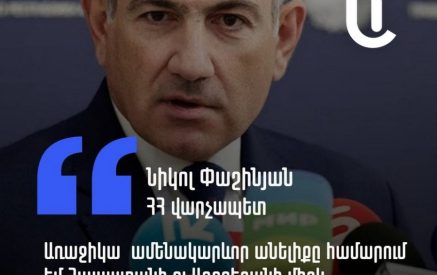





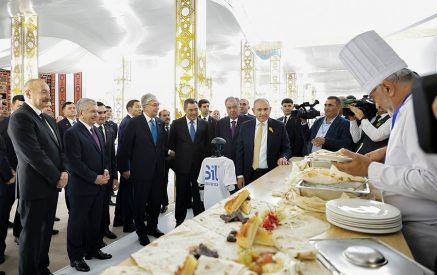

















Speaking at the Shanghai Cooperation Organisation summit in Bishkek, Nikol Pashinyan presented his formula for sovereignty and independence as the product of a balanced and balancing foreign policy. From this, Pashinyan inferred that the absence of conflict is necessary to ensure sovereignty and independence. In this way, he “internationally” packaged what he has repeatedly stated in plain terms from Armenia’s domestic political platforms: that Artsakh was sacrificed for the sake of Armenia’s independence.
On the one hand, there is little need to point this out; on the other, perhaps it is always necessary to expose the manipulative nature of this statement and this “admission.” Because if Nikol Pashinyan consciously sacrificed Artsakh for the sake of Armenia’s independence, then he should thank Russia for not preventing that sacrifice and for helping Armenia achieve its independence. After all, if Russia had carried out, so to speak, an effective peacekeeping mission, Pashinyan would not have been able to sacrifice Artsakh for the sake of Armenia’s independence.
Meanwhile, both directly and through his pro-government propaganda satellites, Pashinyan has repeatedly promoted — and continues to promote — the claim that it was Russia that sacrificed Artsakh. His National Security Council secretary, who is now a former secretary, had essentially stated this in plain terms himself. This makes the manipulation more than obvious: with his “right hand,” he declares that everything was consciously sacrificed in order to break free from the “rope,” while with his “left hand” he claims that it was the Russians who surrendered Artsakh.
Moreover, in presenting both versions, Nikol Pashinyan combines them with a profound imbalance in his domestic political conduct — both in the tone of his rhetoric and in the meaning of certain actions. Yet the foundation of any country’s sovereignty is internal balance, in every sense of the word. In the absence of that foundation, talking about external balancing means engaging in manipulation, not politics.
Read also
And when the force at the helm of a state engages not in politics but in manipulation, then politics itself ends up dealing with that state — with all the grave consequences that follow.
Hakob BADALYAN