








Euneighbourseast.eu. Behind every discussion about Ukraine’s recovery sits a blunt question: who will rebuild the country? Some 1.7 million young people have left since 2022, hundreds of thousands defend it on the frontlines, and roughly two million are NEETs – not in education, employment or training – according to figures from UNICEF and Ukraine’s Ministry of Youth.
The government is now seeking the backing of its international partners, the EU first among them, to give this generation a genuine foundation for a peaceful future once the war, whenever and however it ends, is finally over: quality education and dignified work, in a labour market that has proved remarkably buoyant despite the invasion.
These questions ran through this year’s Ukraine Recovery Conference in Gdańsk on 25 June, where a panel moderated by Andreas Schleicher of the OECD, with Pilvi Torsti of the European Training Foundation (ETF) and diplomats from Poland, Ukraine and Japan reasserted the place of education at the heart of recovery.
But the argument was made most forcefully by two young Ukrainians whose stories capture the choices facing an entire generation, during a separate workshop attended by Torsti in Gdańsk.
Read also
The pair exemplified two interlinked perspectives of the country’s youth: those outside Ukraine, like Anastasiia, aged 17, who founded an NGO in Kraków to support Ukrainian young people, both at home and in exile; and those who never left, like Ruslan, aged 22, a war veteran whose account of returning to civilian life added a truly human dimension to the somewhat hackneyed term “resilience”.
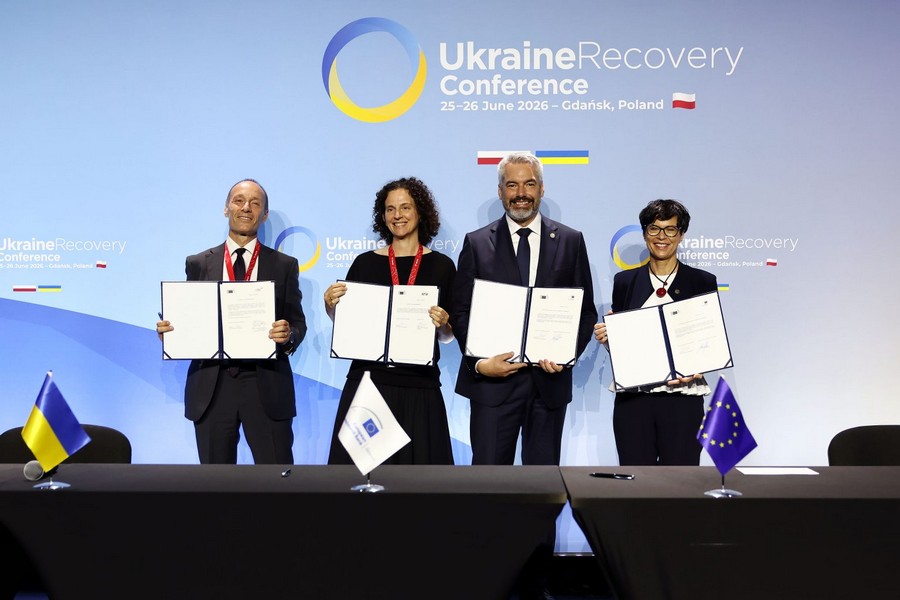
Commissioner Marta Kos during signature ceremony at Amber Expo on June 25, 2026, in Gdansk, Poland. Photo: Piotr Matusewicz/European Commission
Resilience, though, is not only a personal quality: for Ukraine it is an economic necessity, and it raises a practical question. What kind of work will the country actually need? The contours of Ukraine’s future labour market are already visible. Half of Ukrainian companies say workforce shortages are blocking their business development, according to the National Bank of Ukraine’s quarterly enterprise survey, and the government’s first long-term labour market forecast, published this year, estimates that the economy will need some 2.6 million new workers by 2036.
Reconstruction sits at the centre of the forecast: demand for construction workers could more than double, from around 520,000 in 2025 to over 1.2 million, alongside engineers, architects, doctors, rehabilitation specialists and psychologists, the last two a reminder that rebuilding a country also means rebuilding its people.
Reconstruction is an obvious pressure point. The IEA notes that over a quarter of Ukraine’s workforce has been lost to military service or displacement, with shortages in some construction firms running as high as 40%, and a projected shortfall of more than 500,000 skilled workers as the country repairs its grid and modernises its building stock to EU standards. Then come the teachers, the digital specialists, the lawyers and officials who will have to master EU rules as accession advances. The jobs will be there. Whether the young people will be, and with the right training, is another matter.
Filling that gap is precisely what the EU Youth Guarantee was designed for: Member States commit to offering every young person a good-quality job, continued education, an apprenticeship or a traineeship within four months of leaving school or becoming unemployed.
“To me, the Youth Guarantee is not just about employment and apprenticeships for young people. It is about EU integration: it is our chance to demonstrate that we are capable of following that path. There will be challenges, maybe failures, but this is our future,” said Dariia Andriunina, Director of the Department for International Cooperation at the State Employment Service.
ETF Director Pilvi Torsti was among the architects of its inauguration in Finland, back in 2013, before it grew into a Union-wide policy and, more recently, a prerequisite for accession candidates such as Ukraine, Moldova and the Western Balkan states.
Closing her remarks on the panel, Torsti, who served as State Secretary in three different Finnish ministries between 2013 and 2023, put it plainly: “Every time someone tells young people they are the future, they should answer, ‘in fact, we are the present. The action starts now.’” Anastasiia and Ruslan would agree, and so did Yulian Kritsak and Olena Podobied-Frankivska, two of the leading youth figures in Ukrainian civil society.
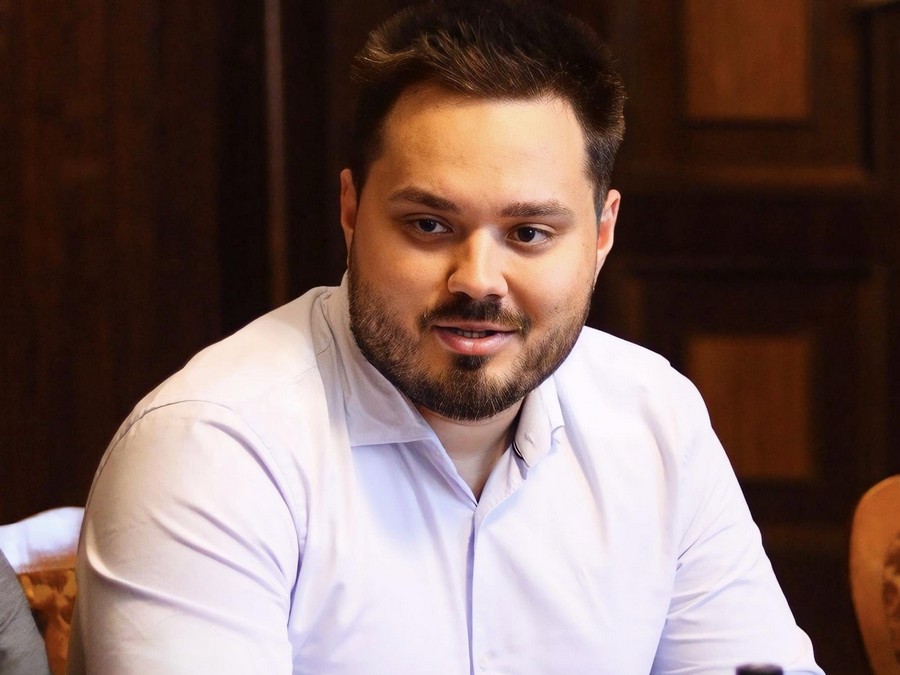
Julian Kritsak. Photo: Andrea Braschayko/OBCT
Kritsak co-founded the NGO 3.5%, based in the multicultural Transcarpathia and named after a theory that an active minority of this size can effect societal change through its own actions.
Podobied-Frankivska is Executive Director of the National Ukrainian Youth Association (NUMO), the umbrella body of the country’s youth associations. Keen-eyed followers of Ukrainian affairs may recognise her from Evgeny Afineevsky’s celebrated documentary Winter on Fire, which chronicled the Euromaidan protests, known in Ukraine as the “Revolution of Dignity”.
Olena was among the hundreds of thousands of young Ukrainians already on the square back in 2013, and she reminds us that before then “there was no framework whatsoever for youth policy in Ukraine, beyond the old Soviet dogmas”, like the Young Pioneers or the Komsomol, relics of a world that no longer exists.
Over the past decade there have been improvements, but as Olena recalls, “at international workshops, I often find that European colleagues assume Ukraine has almost a century of experience in youth policy, the way several European states do, when in fact we’re talking about barely ten years, and our primary need is to expand youth infrastructure so that these policies can actually work.”
Layered on top of this is the more direct effect of the war itself. According to a British Council study from November 2024, young Ukrainians tend to steer clear of long-term planning altogether, rarely looking beyond the month ahead, their hopes for the future remaining hostage to the outcome of the ongoing war.
A growing rift has opened up alongside this, both physical and psychological, fuelled largely by social media, between young people who chose to stay and those who chose to leave the country. “I understand some people’s frustration with those who decided to leave,” explains Yulian, who, at 28, has never once considered leaving Transcarpathia. “Sometimes it’s even an unconscious mechanism to reinforce your own resolve to stay. But I don’t see open hostility, and I don’t think this rift will flare up after the war, unless some political force tries to artificially exploit this divide for its own gain.”
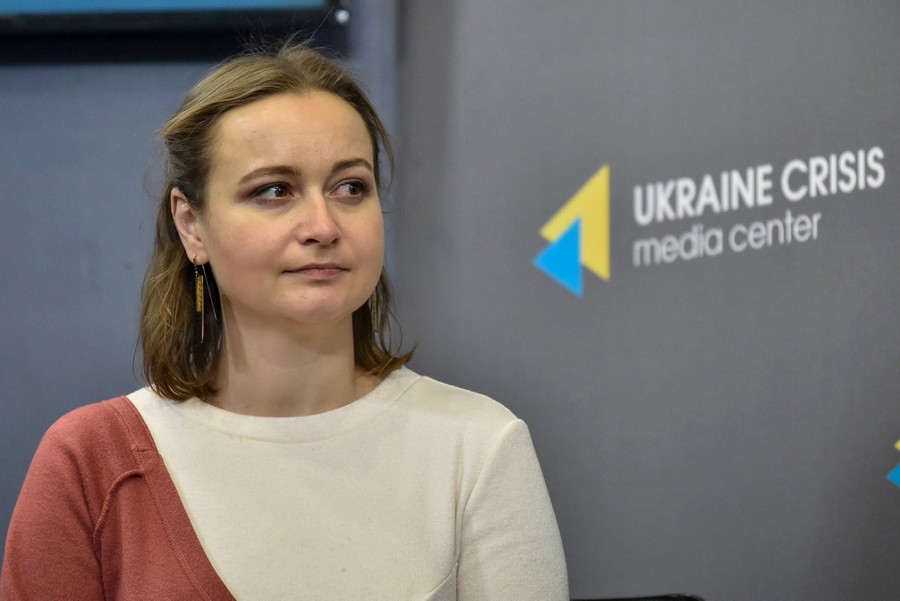
Olena Podobied-Frankivska. Photo: National Ukrainian Youth Association (NUMO)
Millions of Ukrainians, including a significant share of young people, now live abroad as a result of the war. “Many of us are waiting for these Ukrainians to come back,” says Olena, “but I don’t think most of them will, whatever the hopes of Ukrainian society and government might be. Ukrainians adapt very easily abroad, and they’ve become a valuable resource for the countries that host them. Unfortunately, I don’t see any structural effort regarding the Ukrainian diaspora [itself divided, ed.], yet this should increasingly become a priority.”
One of Ukraine’s main challenges, since 2014 but even more so after Russia’s full-scale invasion and the formal opening of EU accession talks, is making reforms feel tangible to a population exhausted by years of resistance. “European integration becomes meaningful not when legislation is adopted, but when young people can see new opportunities in their own lives. Our task is not to persuade young Ukrainians to stay or return, rather to create the conditions in which they choose to do so. By investing in education, skills and quality employment, we are investing in a generation that will lead Ukraine’s recovery and strengthen its place in the EU,” Andriunina says.
As is well known, in 2022 the Ukrainian government was forced to ban men aged 18 to 60 from leaving the country. When it eased the rules for those aged 18 to 22 in August 2025, border data recorded some 96,000 exits within three months – roughly one in seven men in this age bracket, according to Ukraine’s Centre for Economic Strategy – though these figures count crossings rather than departures for good: they do not capture how many later returned, or the same person crossing more than once.
An analysis by the Kyiv Independent, tellingly titled “Youth Exodus”, drew on a survey by the recruitment platform Robota.ua: 71% of Ukrainian companies reported a rise in resignations among younger staff after the government’s decision, and 38% called the departures significant. Sales and customer service took the hardest hit, though even the IT sector, with its high salaries and skilled jobs, ranks among the most affected.
All this deepens a shortage that predates the rule change and bites hardest in male-dominated industries like metallurgy, where companies have been retraining women for jobs traditionally held by men. It has softened the gap without closing it, and over half of the firms surveyed say finding young recruits has become much harder.
At the same time, UNHCR research shows that Ukrainian refugees, young and old, are far from a burden on their host countries. In Poland, for instance, they are estimated to have generated 2.7% of the country’s GDP in 2024. This is where competing interests come into play, between a Ukrainian government eager to entice back some of the young people it helped educate, and (some) EU Member States who have every incentive to hold on to a workforce that is skilled and already socially integrated.
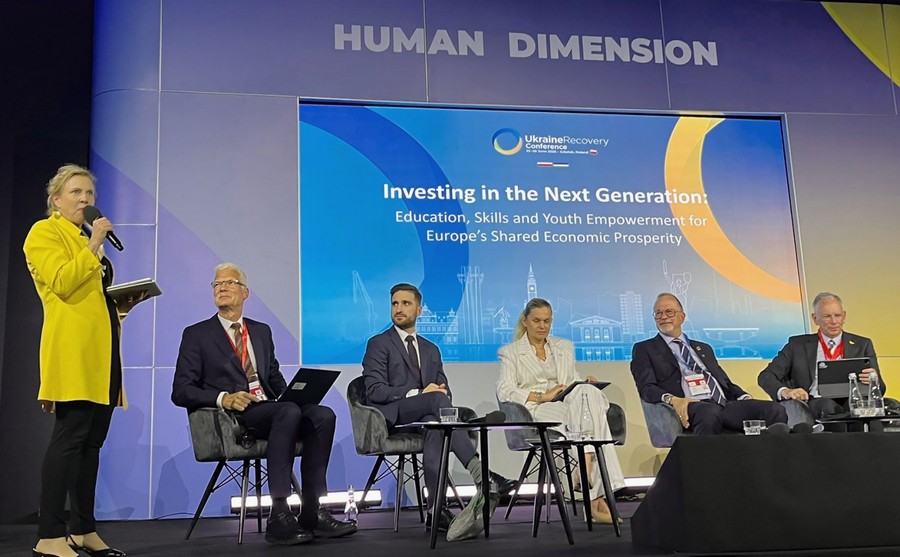
Pilvi Torsti speaking in a panel at the 2026 URC in Gdańsk . Photo: Andrea Braschayko/OBCT
Caught between these two stools sits the work of the European Training Foundation, which, along with the various forms of support it provides the Ukrainian government (from data collection and assistance measures for Ukrainians arriving in the EU to policy advice on education and labour reforms, including the Youth Guarantee mentioned above), also works alongside EU Member States through joint initiatives such as Team Europe.
As Torsti, Director of the ETF, explains, “our role is to be long-term partners, provide evidence and a space for dialogue, connecting different actors, with the Youth Guarantee being a good example of this. It has been implemented across EU Member States, offering different experiences and different forms of added value in each.” Ukraine, for its part, wants to raise the scheme’s age limit from 30 to 35, under the supervision of the Ministry of Youth and Sports. This points to the need to limit damage to what might be called a ‘semi-lost generation’. Podobied-Frankivska points out that “while in other countries, children and teenagers studied remotely for only two years during the pandemic, in Ukraine, we have already experienced six – a generation entirely different, even in how it socialises, compared with the one before it.”
For the “luckier” young Ukrainians, those who have studied or worked in Europe, different paths have also opened up, namely whether to stay or go. “Brain drain is a very complex, multidimensional issue, some countries also experience brain gain,” Torsti explains and continues. “Just think about knowledge transfer. It isn’t a one-way process, and we’re talking not only about societies but individuals too, which is why a moralistic approach to this is unhelpful. As an EU agency working in line with the European Commission’s priorities, but also for the prosperity of the EU’s neighbourhood, our goal is to feed that mutual benefit through data and policy advice.”
Torsti recalls the myth of the “Polish plumber“, conjured up in the media ahead of the 2004 EU enlargement, which saw ten new countries from the former Iron Curtain, plus Malta and Cyprus, join the EU; a myth that later proved entirely unfounded.
Yulian Kritsak is particularly pleased about the recent decision to open up the European Social Fund Plus (ESF+) to Ukraine. “Partnerships with key EU institutions and stakeholders, especially through transnational projects, are helping us gain EU expertise and experience on our way towards EU integration. Without the Youth Guarantee, for instance, we wouldn’t have had a framework to focus on NEETs, which is why these partnerships are key to identifying and supporting Ukraine’s new generation of young people.”
Kritsak argues that European support is crucial not just for the money involved, but above all, for the expertise. “Organisations like the ETF,” said Kritsak, “help us most with this, granting us access to the knowledge we need for Ukraine’s reforms, not only through individual expertise but as a channel into a whole set of frameworks and recommendations that will be essential when we finally achieve EU accession.”
So, when will that accession come about? An earlier instalment in this series mapped out where Ukraine currently stands on its path towards joining the EU, inevitably shaped by the uncertainty of the ongoing war and its eventual outcome.
But when do Ukrainians themselves want to join? Kritsak’s answer splits the question in two. “As a Ukrainian, I’d want it as soon as possible; tomorrow if I could,” he stated. “As an economist, my answer is: when we’re genuinely ready. I wouldn’t want Ukraine to join as some lesser country compared to others, because that would be the wrong outcome for everyone involved.” This also references a plan floated by German Chancellor Friedrich Merz earlier this year, which would have granted Ukraine early access to the EU’s institutions but without voting rights and without a Commissioner holding a portfolio. An empty offer, at least according to Kyiv, and one that President Zelensky flatly rejected.
Pilvi Torsti, for her part, points out that the mission entrusted to EU bodies like the ETF is to work towards reinforcing long-term stability within the EU and its neighbourhood. That neighbourhood has, of course, been visibly shaped by recent geopolitical upheavals, which go well beyond Moscow’s expansionism alone. It is a difficult moment for international cooperation, yet it remains the only available route towards a shared, peaceful and, above all, prosperous future for Ukraine’s young and not-so-young alike, as well as for the other countries still waiting at Brussels’ doorstep.
The ETF’s Director experienced a comparable situation first hand in her work in Bosnia and Herzegovina in the immediate aftermath of the Yugoslav conflict, the scars of which are still visible today, though somewhat tempered by the region’s shared determination to join the European family.
Perhaps it is Olena Podobied-Frankivska, who has been fighting this particular European battle since its earliest days on the streets of Kyiv in the autumn of 2013, who captures it best: “We want to shift from survival mode to development mode.”
Whether that shift succeeds will not be decided in Kyiv alone. The young Ukrainians studying in Kraków, working in Berlin or waiting to come home are already part of Europe’s story, and what the EU invests in them today it will find again tomorrow, in its newest member state. Now seems as good a moment as ever to begin that journey.
Author: Andrea Braschayko
The original article was published in Italian by OBCT