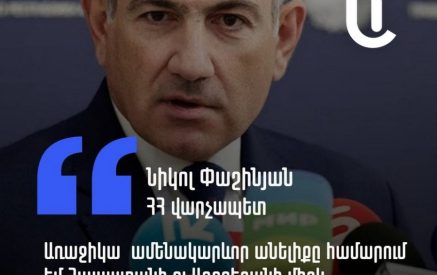


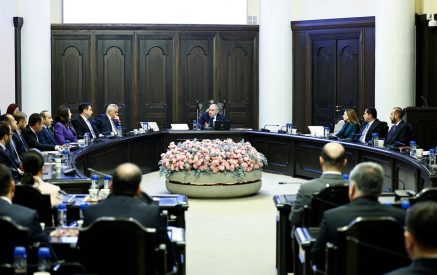












Nikol Pashinyan has said that he considers the ratification of a peace agreement between Armenia and Azerbaijan his most important upcoming task. Speaking at yesterday’s Cabinet meeting, he said he had set himself this specific objective and a timeline extending to 2031. Pashinyan had announced three days earlier that he had set himself this goal. But it turns out that he envisages a five-year period for achieving it. Of course, he has not said that the agreement will be signed in 2031 specifically, but he is evidently so skeptical that he has set a five-year deadline, at least, for “achieving this priority goal.”
And this is despite the fact that the agreement has already been initialed. In other words, all that remains is to sign and ratify it. Of course, Azerbaijan has set a condition: Armenia must amend its Constitution. Does Nikol Pashinyan believe that this could take up to five years? Or is he convinced that meeting this condition will not lead to the agreement being signed and that Azerbaijan will come up with another condition or pretext, because it has no interest in signing and ratifying the agreement?
But perhaps it would not be superfluous to consider another possibility as well. Could it be that Nikol Pashinyan himself is not actually interested in the swift signing and ratification of the peace treaty, and that his statement about 2031 gives precisely that away? After all, this is an issue that allows him to maintain “demand” for himself, both among certain segments of Armenian society and among international actors. Accordingly, abandoning this issue would not serve Pashinyan’s interests. After all, in that case, he would no longer be able to respond to any criticism from the opposition by claiming that they are “provoking war” or “obstructing peace.” Broadly speaking, if the peace treaty is signed—whether that is good or bad is beside the point for now—Nikol Pashinyan would become significantly “redundant” in political terms, losing a substantial number of his political cards.
Meanwhile, if, for example, the issue is dragged out through various mechanisms until 2031, it could even serve as the central theme of the campaign for the next parliamentary elections scheduled for that year. Or it could become the principal achievement of the electoral cycle presented during the campaign, allowing him to make an impression on a certain segment of the electorate while the issue is still fresh. Moreover, Azerbaijan might even accommodate him in this regard, if only to avoid “losing” Nikol Pashinyan for at least another five years. Especially since, in exchange for this support in delaying the signing of the peace treaty, Azerbaijan would presumably get its price from Pashinyan himself.
Read also
Hakob BADALYAN