


















































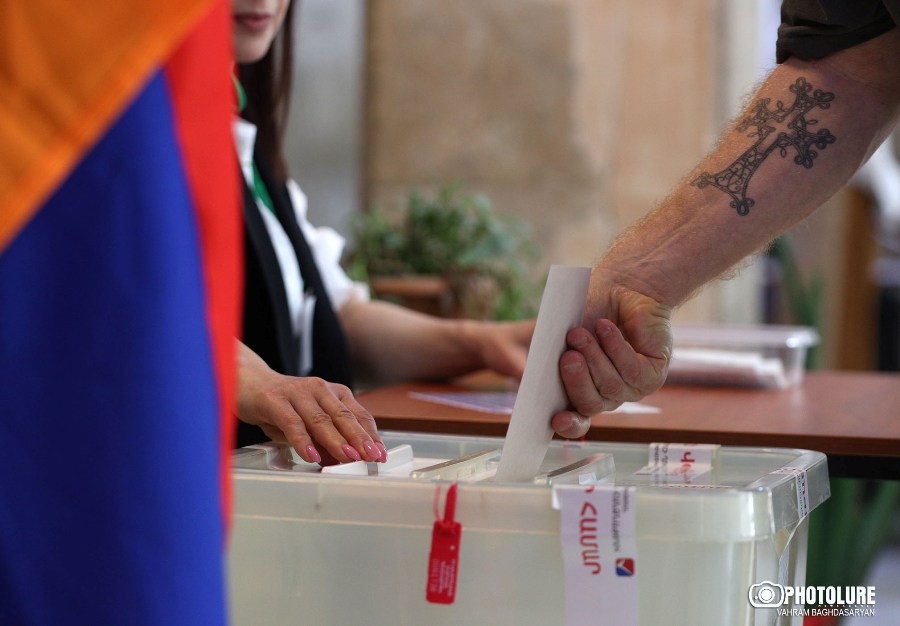
Mirrorspectator. As the final results of Armenia’s parliamentary elections were tallied, several leading opposition groups have issued a statement suggesting Prime Minister Nikol Pashinyan’s government is illegitimate, accusing his administration for bearing full responsibility “for any further escalation of the situation.”
According to the final results, the ruling Civil Contract party will hold 64 seats in parliament, while Strong Armenia secured 29 seats and the Armenia Alliance won 12. The opposition Prosperous Armenia party led by tycoon Gagik Tsarukyan has failed to pass the 4 percent threshold required to enter parliament, receiving only 3.9893 percent of the vote.
The final results followed recounts at several hundred polling stations, as well as decisions by the Central Electoral Commission (CEC) to invalidate the voting results at three polling stations.
Following the announcement, six opposition groups — the two which cleared the threshold, Prosperous Armenia, Bright Armenia Party, the Armenian National Congress, and the National Democratic Pole Alliance — issued a joint statement declaring that “the results recorded in such conditions cannot serve as a basis for the formation of a legitimate government.”
Read also
The statement accused Pashinyan’s administration of bearing full responsibility “for any further escalation of the situation.”
The opposition groups cited what they described as numerous violations, including the detention of opposition figures ahead of the vote, the authorities” use of administrative resources, and the invalidation of results at three polling stations.
At present, it remains unclear whether the two opposition blocs that entered parliament — Strong Armenia and the Armenia Alliance — will accept their mandates. Opposition representatives have indicated that their next step will be to challenge the results before the Constitutional Court.
In turn, the CEC defended its decision not to organize repeat voting in the three affected polling stations, noting that invalidated results do not automatically require a repeat vote. In particular, they highlighted that a partial repeat vote could encourage tactical voting, as voters would already be aware of the broader election results when casting their ballots.
By Arshaluys Barseghyan
(This article originally appeared on www.oc-media.org on June 15.)
Read more at the source