
































But the idea of removing the Catholicos and independent-minded bishops from office is meeting fierce resistance
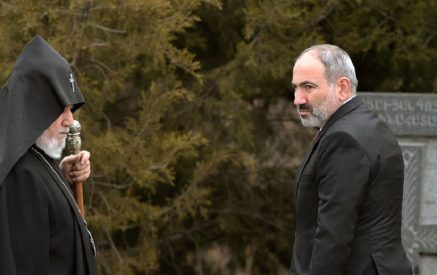
The Pashinyan regime’s “trial” of the Catholicos of All Armenians and the bishops has been postponed. The entire case, of course, is absurd on its face: putting clergymen on trial for carrying out their canonical duties would go down in the annals of global legal practice as one of the greatest curiosities of all time.
On August 7, Judge Hakob Manukyan, hearing the case, recused himself, citing, it seems to me, rather unconvincing reasons. The obvious reason, in my view, is that such a trial should not exist in the first place. And there are two possible explanations: 1) the judge did not want to discredit himself by taking on such a case; or 2) this is a deliberate plan coming from above, because the authorities have calculated the consequences of the absurdity they themselves initiated.
The first possibility, whatever reservations one may have, speaks in the judge’s favor. I am certain that there are people within the judicial system, as well as the Prosecutor’s Office and investigative bodies, who have a proper understanding of professionalism, as well as human and national dignity.
Read also
If this hypothesis is correct, it is quite likely that Pashinyan will order the judge’s property to be “checked,” just as he did in the case of former government staff official Liparit Drmeyan. That official had merely expressed an opinion that did not correspond to the political and personal obsessions of the Civil Contract leader. As a professional, he was obliged to do so, since he was paid by the state, not by Pashinyan. For expressing his opinion, he was dismissed from his job and branded a “Trojan horse” and a potential corrupt official.
A judge, too, is a representative of the state, not of Pashinyan, and if he sees circumstances that prevent him from hearing a case, he is obliged to raise them. So, let me repeat: it would hardly be surprising if “illicit assets” were discovered in Hakob Manukyan’s possession, or if it turned out that he had made calls deemed unconstitutional. Whether such a “discovery” would be accompanied by a masked raid by NSS officers and the judge being thrown to the ground would depend on the Civil Contract leader’s mood at the time.
But is it worth considering the possibility that Pashinyan, seeing that his obsession with removing the Catholicos and bishops who refuse to obey him is meeting fairly fierce resistance both inside the country and in the Diaspora, has decided to back down or postpone the implementation of this idea, and that the judge’s recusal should be viewed in precisely that context? I think not. That is not possible.
Knowing the nature of the current regime and the Civil Contract leader, I tend toward the first hypothesis. When some delusional fantasy takes hold of Pashinyan, I believe it is pointless to speak of calculated moves at all.
Recently, for example, it emerged that Armenia wants to integrate with the EU not because European values are particularly close to our hearts, not because the European market is economically more advantageous for our goods, and not even because Macron or von der Leyen are directing the Armenian government.
No, the reason is more “interesting.” It turns out that Pashinyan took offense at Belarusian President Lukashenko, who insisted that Armenia “has nowhere to go and nobody is waiting for it,” and decided, just to spite Lukashenko, to prove that we do have an alternative, that there is somewhere for us to go, and that we are expected there.
Under conditions of such, to put it mildly, infantilism, it is difficult to expect that some moves are being carefully calculated “at the very top.” Otherwise, childish “explanations” for the steps being taken would not be offered.
Aram ABRAHAMYAN