


































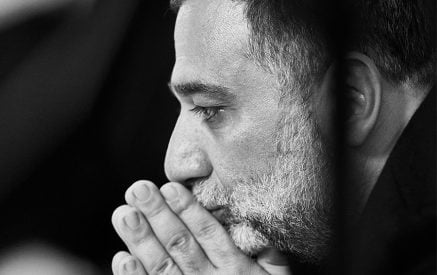









“I decided to stop drinking, stop smoking, and stop having casual sex. I lasted a week. Then I realized I had lost a week of my life.
Roman Kupchinsky
From Kupchinsky’s words, one can infer that if a person has no higher purpose in life, giving up habits that harm one’s health may simply be perceived as voluntarily depriving oneself of pleasure.
Why should someone give up pleasures that bring enjoyment if nothing is gained in return?
Read also



This brings us to the question of purpose.
Abandoning harmful habits should serve a greater purpose. That purpose is participation in the mission of the Armenian people: contributing to the establishment of order in the world and to the development of planet Earth. These ideas were discussed in the first and second parts of The Strategic Armenian article.
If a person considers themselves a participant in that mission, they become one of the driving forces behind it. Through their knowledge, health, time, and energy, they help move that mission forward. The more effectively a person functions, the faster and more steadily the mission advances.
For the strategic individual, therefore, health is not merely a personal value – it is a strategic resource.
One should strive to live as long as possible, preserve both physical and mental capacities, maintain a clear mind, sustain sufficient energy, and use one’s time with maximum effectiveness.
It follows that if behavior harmful to health is within our own control, then abandoning it becomes not only a matter of healthcare but also a strategic decision. This includes excessive alcohol consumption, smoking, habits that lead to obesity, and any actions that knowingly diminish a person’s capabilities.
For example, if someone declares that their goal is the return of Artsakh or the strengthening of Armenia, yet spends years undermining their own health, then their actions contradict the very purpose they have proclaimed. They weaken the primary instrument through which they could have served that purpose – themselves.
The same reasoning, however, should not be mechanically applied to every form of pleasure.
For example, sexual relationships cannot, in themselves, be classified as either beneficial or harmful. Everything depends on their consequences. If they contribute to a stable family, mutual trust, and a person’s inner balance, they may even strengthen one’s ability to serve their purpose. But if they destroy a family, undermine trust, or damage the relationships upon which a person’s work and mission depend, then they too become strategically harmful.
Strategic thinking is not moralizing. It is a calculation.
The question is always the same: Does this choice increase my ability to serve my purpose, or does it diminish it?
Hovhannes Ishkhanyan
In the first part of The Strategic Armenian, it was discussed that one of the possible forces capable of restoring order and justice in the world is the Armenian people.
In the second part, it was argued that to fulfill that mission, national identity must be elevated to a supranational level — a consciousness of being useful to planet Earth.
Next, we explore what kind of thinking, behavior, and way of life are necessary for this national-supranational mission to succeed. You can also read: Part 3.1 Rise Above Offence | Part 3.2 Restrain Your Opinion | Part 3.3 No Single Right Way
Part four shows that the Strategic Armenian is immortal.