













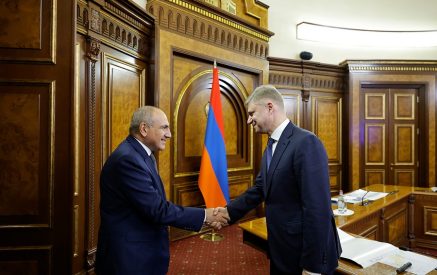




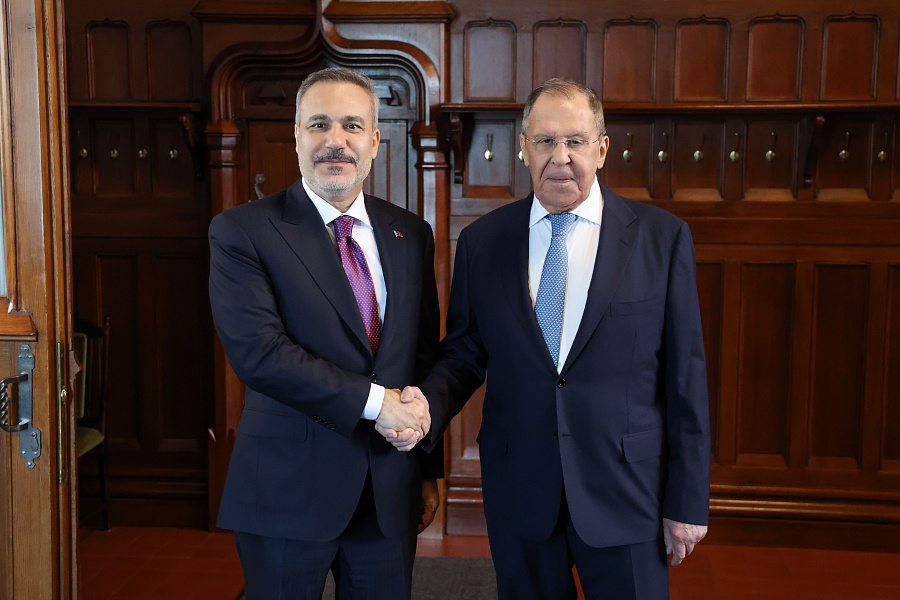
The foreign ministers of Russia and Turkey have met in Moscow. Turkish Foreign Minister Hakan Fidan arrived in Russia on a two-day visit. Following the Lavrov–Fidan meeting, the two officials stated that they had also discussed issues related to the South Caucasus.
Russian Foreign Minister Sergey Lavrov said that the sides had agreed to “work closely together” on regional matters, while Fidan noted that they had held “detailed discussions” on a range of issues, including the so-called Armenian-Azerbaijani peace process. According to Fidan, that process is of particular importance for peace in the region.
The “detailed discussions” mentioned by Fidan likely mean that one of the key “details” of recent weeks was also addressed: Armenia’s parliamentary election and its outcome. It is difficult to imagine a detailed discussion of South Caucasus affairs that would not include Armenia’s election. Yet Moscow’s and Ankara’s post-election reactions appear to have differed significantly.
Ankara welcomed the officially announced results and expressed satisfaction with them. Russia, by contrast, has treated the outcome as controversial, ambiguous, and questionable. Such characterizations have been voiced by representatives of various Russian state institutions. Meanwhile, Vladimir Putin has yet to congratulate Nikol Pashinyan. He may be waiting for their anticipated meeting in Moscow in the second half of June, which Pashinyan himself mentioned during the election campaign.
Read also
If Lavrov says that the two countries have agreed to “work closely together,” a legitimate question arises: does that also extend to their post-election approach toward Armenia? Will Moscow and Ankara narrow the gap between their publicly stated positions behind the scenes, or will they cooperate closely on regional issues while simultaneously competing fiercely over Armenia’s post-election realities?
The Moscow meeting, at the very least, revives that intrigue. For the region—and for Armenia in particular—this is hardly a new one. Russian-Turkish rivalry, as well as the possibility of Russian-Turkish understandings, has long been a familiar feature of regional politics.
The real issue, however, is that every new phase, while repeating an old logic, comes with a new price tag—one that Armenia is likely to be asked to pay.
The deeper problem, and the most serious concern, is that this electoral process has left Armenia vulnerable to external pressures of all kinds. It could hardly be otherwise when the authorities proclaim an overwhelming victory while that victory lacks a a credible basis in both public sentiment and the vote itself.
Under such circumstances, the external incentive to extract concessions from Armenia only grows stronger. And in the process of either coordinating or competing over those concessions, it will not be only Russia and Turkey that are involved. So too will all the other power centers that openly—and, to borrow Shmays’ famous phrase, “gracefully intervened” in Armenia’s electoral process.
Hakob BADALYAN