

























The St. George Ribbon, Mount Ararat, the Artsakh Flag, and the Map Badge
The St. George ribbon has been known in Russia since the reign of Catherine the Great as a symbol of the military and martial glory. During the Russian Civil War, it was often worn by members of the White movement fighting against the Red Army. During the World War II, the ribbon was also used by some Russian collaborators who sided with Nazi Germany. At the same time, a similar ribbon accompanied certain Soviet military decorations.
In contemporary Russia, the tradition of commemorating May 9 with St. George ribbons initially emerged as a grassroots initiative. Around 2006, however, the Russian authorities began appropriating that initiative. Following the annexation of Crimea in 2014, the ribbon evolved into a symbol of support for the state’s policies. By the end of 2022, amid Russia’s full-scale war against Ukraine, it was formally granted official legal status.
In 2015, when I was invited during a program on Armenia’s Public Television to pin a St. George ribbon to my jacket, I declined. For me, it symbolized—and continues to symbolize—the aggressive, imperial policy of Putin’s Russia. At the same time, I had no objection whatsoever to the forget-me-not flower as a symbol honoring the victims of the Armenian Genocide.
Read also
The St. George ribbon did not carry the same meaning in 2000 as it did in 2022. The evolution of its symbolism moved from a simple expression of remembrance for war and military service to a distinctly political instrument. Today, that symbolism may be viewed positively—as I believe it is by the majority of Russian citizens—or negatively, as in my own case. In either instance, however, the meaning of the symbol has now crystallized—or, to borrow the terminology of semiotics, become “condensed”—and it is unlikely to undergo any significant transformation in the foreseeable future.
Altering the meaning of a symbol is generally a difficult process; it cannot be accomplished overnight through directives issued from above. This is especially true of ancient symbols with centuries-old, even biblical, roots. No matter how insistently Armenia’s official propaganda may try to convince people that Mount Ararat is a symbol invented by Russia, the Soviet Union, or the KGB, the facts tell a different story. A member of the Armenian diaspora who hung a picture of Ararat on the wall of a home in Beirut or Los Angeles almost certainly had no connection to either the Soviet Union or the KGB—and may never even have visited Soviet Armenia. Nor is it possible to rewrite history by changing the opening line of Gregory of Narek’s hymn on the Resurrection so that Mount Ararat is replaced with another mountain.
Let me offer two more recent examples of this “condensation” of symbolic meaning.
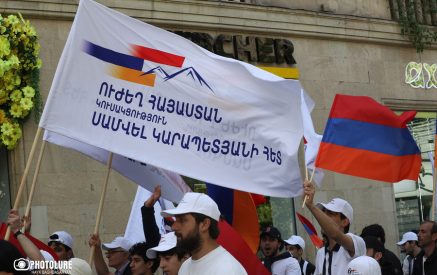
The first dates back to 2021. A university student had attached a keychain depicting the Artsakh flag to her backpack. She got into a taxi, and the driver told her, “I’m not driving anywhere until you get rid of that piece of trash.” For a certain segment of society, the Artsakh flag had come to symbolize the “looters,” the “Karabakh clan,” the “former regime”—along with all the associations that years of Pashinyan’s propaganda had embedded in their minds.
Now consider the opposite example.
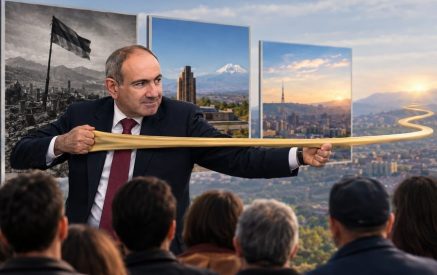
Prime Minister Nikol Pashinyan wears a badge depicting the map of Armenia. Yet because it is a badge, it is no longer merely a map. It has become a symbol of the Armenia created by Pashinyan—his “Real Armenia.” Here again, meaning becomes “condensed.” The symbol is no longer about the outline of the Republic of Armenia, much less about a small piece of cardboard pinned to someone’s chest. People’s attitudes toward it are shaped by the way they perceive Armenia’s current reality.
To me, Pashinyan’s Armenia is an Armenia whose government carries out Baku’s demands—for example, by changing the country’s Constitution. It is an Armenia whose sovereign territory is occupied by Azerbaijani troops. It is an Armenia where mass repression is employed against the opposition; where thousands of people are subjected to unlawful surveillance; where people can be imprisoned for something they say or lose their jobs over a single “like” on social media; where property can be taken away unlawfully. Above all, it is an Armenia that, in my view, no longer has a legitimate government.
Аram ABRAHAMYAN
“Aravot” Daily
07.07.2026