









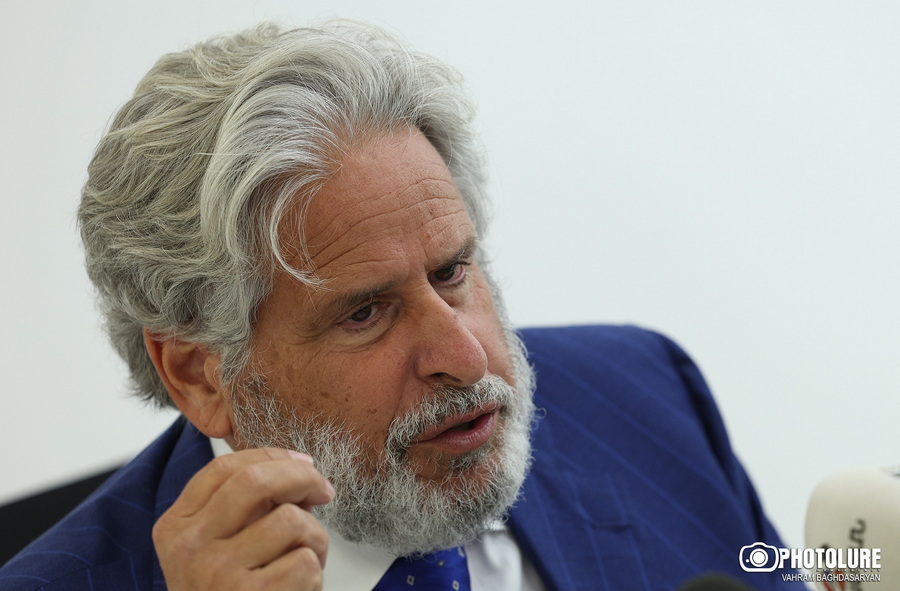
Aravot.am has an interview with Founder and Managing Partner Amsterdam & Partners LLP Robert R. AMSTERDAM.
-In your statement, you noted that Prime Minister Nikol Pashinyan’s actions regarding the Armenian Apostolic Church do not constitute reform, but rather an attempt to politically seize an independent religious institution. In addition to violating the Constitution of Armenia—as noted by local experts—what international legal norms and standards is Prime Minister Pashinyan violating through these actions?
-What is happening today surrounding the Armenian Apostolic Church has nothing to do with reform; it is an overt, aggressive attempt to politically capture and silence a centuries-old independent religious institution. Beyond violating Armenia’s Constitution, Prime Minister Pashinyan is acting outside the framework of internationally binding instruments such as Article 18 of the International Covenant on Civil and Political Rights and Article 9 of the European Convention on Human Rights—in conjunction with Article 11—which protect the autonomy of religious communities and their internal affairs, including issues of their leadership and governance, from arbitrary political state interference. According to international law, the state is obligated to remain neutral and impartial and cannot arrogate to itself the authority to determine the internal life, leadership, or organizational structure of a religious community. International standards set by the Venice Commission and the OSCE/ODIHR are equally clear: the autonomy of religious communities must be protected from political interference by state authorities. When the executive power uses the full force of the state to pressure a religious institution, control its internal life, or interfere in its leadership issues, it thus undermines the foundations of democracy in its country. What is taking place is an authoritarian abuse of state power and a gross violation of religious freedom and the rule of law protected under international law. Such actions cannot remain without consequences.
–A third judge has now declined to preside over the case involving the Catholicos of All Armenians and the clergy. The first judge recused himself, while the subsequent two judges, upon assignment of the case, petitioned the Court of Cassation regarding issues of jurisdiction. In your assessment, are the grounds presented by these judges legally sound, or does this pattern point to judicial systemic constraint, political pressure, and the inherent legal lack of merit of this case?
-The refusal of three judges to examine the case concerning the Catholicos of All Armenians and the clergy clearly demonstrates the deep systemic constraint, political pressure, and complete lack of legal prospects surrounding this case. It is evident that the judges are facing a dilemma: on one hand, there is a clear political directive from the ruling power, open resistance to which carries risks for them; on the other hand, they fully understand the legal absurdity and danger of this process. Nor should we forget the moral and psychological factor: as Christians and followers of the Church, many are simply not ready to become tools for political persecution directed against the Supreme Patriarch of All Armenians. Nevertheless, hiding behind judicial procedural maneuvers or jurisdictional disputes and evading responsibility is not a professional approach. This is merely an attempt to buy time. Judges called upon to administer justice must display integrity, be guided strictly by the Constitution and laws of the Republic of Armenia, examine the case, and reject this unlawful lawsuit, putting an end to this unconstitutional legal precedent.
Read also
-Your client, Samvel Karapetyan, leader of the “Strong Armenia” party, recently won a defamation lawsuit against blogger Roman Baghdasaryan, whom the court ordered to issue a public retraction of his defamatory claims regarding “defrauding and looting the state.” As an international lawyer, how do you assess this verdict, and does it demonstrate that the ongoing media campaigns against Samvel Karapetyan by pro-government circles are based on defamation and political motives?
-This verdict establishes a rock-solid legal fact: So many of the defamatory statements and accusations continually leveled against Samvel Karapetyan by pro-government circles are nothing more than an orchestrated, politically motivated campaign. As an international lawyer, I view this as a critical legal precedent (res judicata). The court has officially validated what we have maintained from day one: so many of the statements propagated by pro-government circles and their affiliated media outlets lack any factual or legal basis. This is not merely a victory over a single blogger; it officially dismantles the core narratives of the character assassination campaign waged against my client.
-How do you evaluate the latest developments in Armenia, where legal proceedings have entered a new phase with the detention of opposition leaders? Expert commentary suggests that the judiciary is acting on direct instructions from Prime Minister Nikol Pashinyan. Can Armenia pursue EU integration through such practices, especially given the silence of international human rights organizations?
-The detention of opposition leaders and the politically driven legal proceedings in Armenia demonstrate that the country has veered off the democratic path. When the judiciary is transformed into a tool for executing the executive branch’s political directives, the rule of law simply ceases to exist. At first glance, it may appear that the European Union and international bodies are turning a blind eye to Prime Minister Pashinyan’s actions, but this cannot last forever. What is currently transpiring in Armenia’s political and judicial landscape has already diverged completely from core EU values, democratic standards, and the principles of the rule of law. It is impossible to genuinely discuss European integration or a European future when fundamental human rights are systematically violated and the opposition is actively targeted.
-How do you distinguish between political persecution and legitimate prosecution for actual criminal offenses? What objective criteria do you apply to ensure your assessment is not merely a reflection of your client’s political stance—particularly given that the Armenian authorities claim these actions are taken pursuant to a public mandate to hold accountable those involved in grand corruption?
-International law has very clear and objective standards to distinguish political persecution from a genuine criminal offense. We are not guided by political statements or assumptions; we rely strictly on cold facts and legal procedures. Political persecution has several overt indicators. The first is the gross violation of the presumption of innocence. When the head of the country and high-ranking officials label a person a “thief” or a criminal from public platforms without a court verdict, that is a violation of the presumption of innocence and direct evidence of political direction. The second is selective justice. This occurs when the law enforcement system exclusively targets opposition figures or individuals undesirable to the authorities, while turning a blind eye to similar or far more severe abuses within the ruling circles. The third is the manipulation of the “people’s demand.” In a state governed by the rule of law, criminal prosecution is conducted based on facts and the law, not political slogans of “popular demand.” Justice cannot be a tool for populism or political vendettas. When a case lacks substantive criminal elements and the accusation is built on political rhetoric, we are dealing not with a fight against crime, but with the weaponization of the justice system into a political tool.
-What specific actions should the international community take if, in your assessment, the Armenian authorities are failing to honor their international legal obligations? What concrete steps do you expect from the European Union, the United States, and the Council of Europe?
-The international community must move away from the selective approaches that are, unfortunately, observable today. Democracy and human rights cannot be tailored to geopolitical expediency; principles either apply universally or cease to hold value. First and foremost, double standards must be eliminated. Our international partners must extend the same objective legal scrutiny to developments in Armenia as they would in any European capital. Second, PACE, EU institutions, and the U.S. Department of State should provide targeted and substantive oversight in their monitoring reports, prioritizing judicial independence, the protection of opposition figures’ rights, and respect for Church autonomy. Third, international assistance and engagement must remain values-based and firmly anchored in measurable indicators of the rule of law and judicial independence. Fourth, it is essential to ensure international monitoring by dispatching observers to high-profile judicial proceedings to guarantee the right to a fair trial. If Armenia seeks to be a full-fledged member of the democratic family, the role of international partners should not be passive acquiescence, but rather guiding the authorities back into compliance with their own international legal obligations.
Tatev HARUTYUNYAN