






















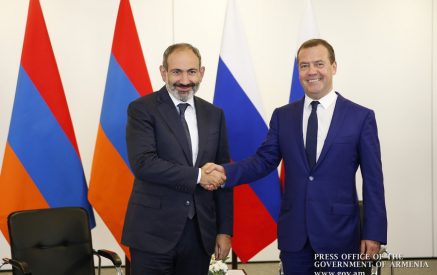

Those who have watched the interviews with Armenia’s second and third presidents and then read the current prime minister’s nervous reactions have rightly noticed that—regardless of the content—what stands out most is the contrast in style, tone, and vocabulary. Pashinyan’s speech is far removed from the norms of political debate: it is undisciplined, quarrelsome, gossipy—fit for a “street brawl.” It reflects not only the intellectual and cultural traits of Armenia’s current leader, but also the mentality of his intended audience—the “people” as imagined by the Civil Contract Party.
The opposition faces a dilemma: should it descend into that “street-fight” arena, where, let’s admit it, the Civil Contract crowd is nearly unbeatable—and whose only real rival might be Vardan Ghukasyan, now residing in the United States—or should it try to remain within the bounds of political discourse? My own view is clear. I find it unpleasant to see opposition figures sometimes succumbing to the same Civil Contract style of personal attacks and smear tactics. Their usual justification is, “We need to speak their language so that the people understand us.” Perhaps they are right. But that particular kind of “people”—the ones who supposedly need such language to understand—have never interested me, whether they number one million or ten.
I want to draw the attention of my readers—the “non-people,” so to speak—to a topic I’ve touched upon many times: the OSCE Minsk Group proposal of 2019. Pashinyan has promised to “scan” and publish certain “negotiation documents.” (Notice the phrasing—documents, not the proposal itself.) It’s clear he will publish only those papers that serve his purpose, accompanied by commentary that also serves his purpose.
Then the government’s propaganda machine will say: “Well, you kept demanding publication—now you see how bad that proposal was?” Or: “There was no real proposal at all.” Or: “We never actually rejected any offer.” A thousand such excuses can be invented—after all, talk is cheap. In any case, those hundred or so pages will be read by maybe ten people at most, while “the people” will absorb only the loud, semi-gangsterish slogans Pashinyan will throw around about those “documents.”
That “people,” of course, are very wise.
Read also
Aram ABRAHAMYAN