
















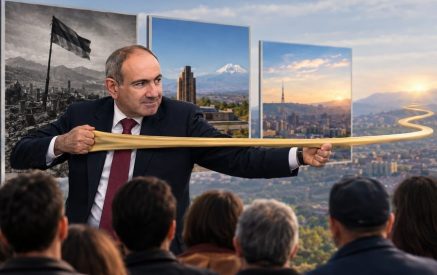







There is a common misconception that Nikol Pashinyan labels the Artsakh movement and everything associated with it a “a rope around Armenia’s neck” and a threat to Armenia’s independence and sovereignty in order to discourage any “mirror response” from Azerbaijan. By the same logic, many assume that his calls to avoid discussing the return of Artsakh Armenians—or of Armenians who once lived in Azerbaijani cities—are intended to prevent Azerbaijan from raising the issue of so-called “Western Azerbaijan.” Pashinyan himself has repeatedly suggested that if Armenia remains silent, Azerbaijan will do the same.
Yet any reasonable observer can see that this has not happened. On the contrary, Azerbaijan has become increasingly vocal and assertive in its demands, openly insisting that Armenia is obliged to accept Azerbaijanis. Whenever such statements are pointed out, no convincing explanation comes from official Yerevan. Needless to say, neither is there any meaningful objection to Azerbaijan’s claims.
Instead, the same mantra is repeated: our policy is peace. It is repeated even when Azerbaijan declares that peace is impossible without the “return of Azerbaijanis.” Moreover, when official statements from Baku are met not with objections from Yerevan but with declarations that “we are building peace,” the message is difficult to interpret otherwise: sooner or later, the process of “building peace” may extend to meeting yet another Azerbaijani precondition for peace—the issue of the “return” of Azerbaijanis.
Returning to the original point, it is a mistake to believe that Pashinyan has closed the Artsakh issue and everything connected to it in order to prevent a “mirror” reaction from Azerbaijan. He did so fully aware that Azerbaijan was not silent and had no intention of becoming silent. Better than anyone else, Pashinyan understands that Azerbaijan’s policy is not driven by reciprocity, but by its ambition to establish unquestioned strategic dominance over Armenia. After all, it is likely that no one hears this more directly than he does during Armenian-Azerbaijani negotiations.
Read also
Pashinyan has closed the Artsakh issue—and everything associated with it—for one principal reason: to create the domestic political environment necessary to preserve his hold on power by turning concepts, historical realities, and established facts on their head. If he does not close this chapter, he has no answer for the forced displacement of Artsakh’s Armenian population and the loss of Artsakh itself. He cannot portray those events as an achievement of sovereignty. And if he cannot present even that as a success, then after eight years in office he is left with no other major issue that can be repackaged—even through distortion—as a political accomplishment.
That is why Pashinyan has “closed” the Artsakh issue. It has nothing to do with blocking a potential “path” for Azerbaijanis into Armenia. If anything, one could argue that the relationship is precisely the opposite.
Hakob BADALYAN