






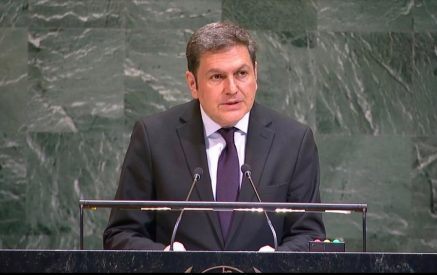
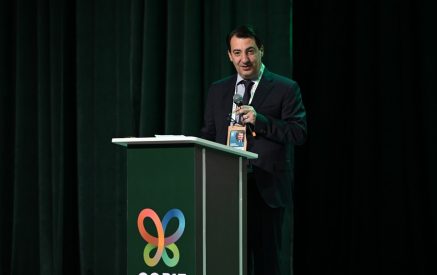
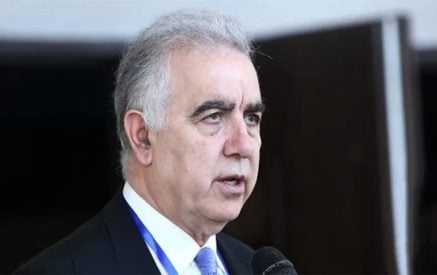


Opening speech by Minister of Foreign Affairs of Armenia Ararat Mirzoyan at the Yerevan Dialogue 2026
Honourable Mr President of the Republic of Armenia,
Honourable Mr Prime Minister
Honourable Mr President of the Republic of France,
Read also
Honourable Mr President of the National Assembly,
Excellencies, Distinguished Guests and Friends,
I am privileged to welcome you back to Yerevan for the third edition of our Dialogue. In a world that increasingly discourages stability and continuity, the fact that we are here again, that this forum has returned, already sends a powerful message.
Forums endure when they have something real to say. I believe we do.
Last year, we met in this very room under the theme “Navigating the Unknown.” We described a world that was lost in a thick fog, as the familiar architecture was crumbling, the rules were fading, and we weren’t sure what was coming next. We brought up compasses and maps, we spoke of tectonic shifts and disorientation. We asked how any of us was navigating in this unknown environment.
Today, that fog has partially cleared. But instead of a calm sea, we see many storms.
The storms we face today are not metaphorical; they are very real and systemic. They test nations, their sovereignty, institutions and individuals alike. Looking at today’s storms, the following broader picture emerges:
- Geopolitical Storm: International law and global order are not just strained, they are being actively dismantled. We see a dangerous shift where the rule of power tends to replace the rule of law. Multilateral institutions designed to maintain order are struggling to assert their authority in a world that no longer waits for their verdict. Nuclear rhetoric, once restricted to the rooms of the Cold War, re-entered mainstream political discourse, which should alarm everybody.
- Technological Storm: technology has moved much faster than our ability to manage the risks and opportunities it brings. Artificial intelligence is no longer a futuristic dream but a present force. Well, we all were smart enough to predict that it would reshape industries, eliminate professions and change the very nature of work. But beyond this, AI has also turned into a powerful tool of manipulation, generating disinformation at an industrial scale, creating false realities and targeting democratic societies with surgical precision.
- Economic Storm: the global market is no longer stable, and recent developments have deeply shaken the belief that open trade benefits everyone. Supply chains that connect continents are easily broken. Swings in energy prices can disrupt national economies overnight. Economic sanctions have become a routine instrument of geopolitical pressure, turning trade into a battlefield.
- Environmental Storm: the natural systems that sustain life on Earth, our climate, water, soil, forests, and biodiversity, are no longer just changing; they are under serious strain. We have moved beyond gradual warming into a period of deep instability, where environmental damage makes every other crisis worse. The biodiversity loss, the land degradation and deforestation weaken nature’s ability to recover, while the overuse of natural resources threatens the balance needed for societies to function.
Those storms have not arrived separately. They have come together, and they reinforce one another. A geopolitical shock drives economic disruption, which fuels a technological arms race, which in turn deepens geopolitical divisions, while environmental change makes all of these challenges even harder to manage.
Ladies and gentlemen,
Armenia knows what it means to be in the centre of the storm. Let me speak openly. Challenges and hardships our country has faced in recent years would have driven many nations toward para՛lysis and the brink of collapse. So, let me share some conclusions:
When a nation finds itself in such turbulence, history offers three broad paths:
- The first is detachment and disassociation: It is the choice to stay on the sidelines, avoid taking actions and hope that remaining detached, the storms will spare you, and your comfort zone and status quo will be preserved. While it may look like a safe choice in the short run, history shows that such detachment doesn’t protect. It merely leaves nations cut from reality, unprepared and more vulnerable, thus strengthening the shock of the strike when the crisis reaches them, and bubble eventually blows up.
- The second is the surrender to the storm: Here you make inefficient, wrong and exhaustive movements, movements that are predictable or even worse – are prescribed by scriptwriters, and ultimately you only help the storm to carry you wherever it chooses. This way, you give up control, you no longer decide your own fate. You become an object rather than a subject of your own history. And merely driven by the current or trying to drift with it, you inevitably risk becoming a victim of decisions made by others and face existential challenges.
- And the third choice: riding through the storm with pragmatism and forward-looking strategy. Looking into the eyes of reality directly instead of avoiding to acknowledge it. Realising that in a volatile world, the only way to ensure at least some stability is to take the steering wheel into your hands and to keep moving forward with a clear, active strategy. And yes, although success is still uncertain, the first two options are certain to be destructive
We, ladies and gentlemen, the Republic of Armenia, we walked through all three paths, we passed all three stages, only in our most recent history. For several decades, we thought we were successfully avoiding storms and preserving our usual zone of comfort by remaining detached. When the crises came, and the imaginary safety collapsed, we found ourselves in a whirlpool, where we were being pulled into the aby՛ss despite all our hard efforts.
And somewhere at that point, we decided to break out of that vicious spiral of history. Not to follow what others have prescribed for us, but to take the responsibility to make our sovereign decisions for our own fate. Not to remain in the past, but to look forward, to build a modern, democratic and prosperous society, a state with real sovereignty, and integrity of precise territory, with its peaceful modus vivendi in this given environment. And this is the exact moment when the concept of Real Armenia was born.
Excellencies, Dear guests,
At a time when everything around us seemed to be falling apart from various storms, we established peace. The Washington Peace Summit on August 8, 2025, marked a historical turning point with the signing of the Joint Declaration by Armenia’s Prime Minister and Azerbaijan’s President, and the US President as a witness. On the very same day, my colleague from Azerbaijan and I initialled the Agreement on Establishment of Peace and Inter-State Relations between the Republic of Armenia and the Republic of Azerbaijan. By committing to the mutual recognition of territorial integrity, sovereignty, and the inviolability of internationally recognized borders, Armenia and Azerbaijan took a historic step toward closing decades of conflict and opening a new era of peace and stability in our region.
Of course, peace must never be treated as a one-time achievement. It requires constant care, attention and reflection, because if you fail to invest in it, you will risk losing it. Peace, therefore, is not an event but an active choice we must make every single day. This, understandably, also involves addressing humanitarian issues, thus contributing to restoring trust and true reconciliation between societies.
But diplomacy alone does not sustain peace. Thus, we create a practical guarantee for peace by making our prosperities interconnected and interdependent. When we share trade routes, energy grids, pipelines, digital links, we share risks and rewards. Therefore, together with our neighbours, by building infrastructure that connects East to West and North to South, we are creating a reality where, in our region, every actor has a personal stake in the stability of its neighbour. This is the foundation of our Crossroads of Peace initiative and the TRIPP project.
The commitment to peace, cooperation and prosperity guides our approach towards our neighbours. The normalisation process with Turkiye reflects our belief that open borders and neighbourly relations will serve our nations’ interests better. With Georgia, we continue to deepen strategic partnership built on mutual interests. With Iran, we have always maintained friendly ties and close partnership.
The strategy of storm-riding has led to a profound transformation in our partnerships beyond our region as well. Armenia has made a sovereign choice to pursue a balanced and balancing foreign policy, based not on dependence on one centre, but on building meaningful and mutually beneficial partnerships in many directions. The United States, France, Kazakhstan, China and a growing number of European partners are now present in Armenia’s strategic partnership portfolio, not as alternatives to one another, but as pillars of a diversified and cooperative foreign policy architecture.
Nowhere beyond our immediate neighborhood has this transformation been more visible than in our relations with the European Union. The Strategic Agenda adopted in December 2025 provides a structured framework for cooperation across political, security, and economic dimensions. The launch of the visa liberalisation dialogue opens a door that matters not only to governments but to the daily lives of Armenian citizens. Just during the last couple of days, heads of state and government from across Europe, spanning from Dublin to Tbilisi, gathered in Yerevan for the European Political Community summit, alongside with the first-ever Armenia-EU summit.
Excellencies, friends,
To conclude: Storms may never be fully tamed. New uncertainties will always emerge to replace the ones we have already overcome.
But the lesson we draw from our experience is not one of fatalism. It is about freedom to choose and power to act. With strategic vision and proper action, small nations can find their way through storms and shape their sovereign, peaceful and prosperous futures.
So, the storms, ladies and gentlemen, are always there. Let us ride together then.
Thank you and welcome to Yerevan Dialogue!
Foreign Ministry of Armenia