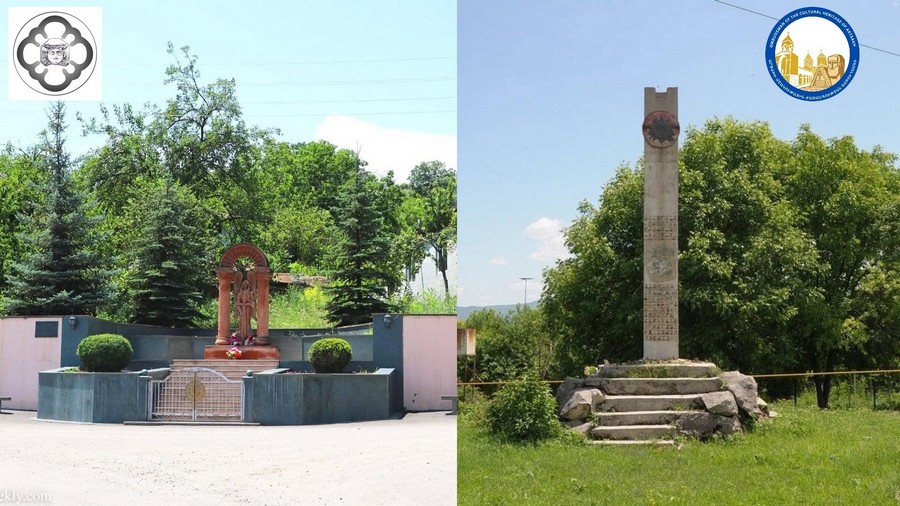
According to a comparative analysis of Google Earth satellite imagery, between 19 April 2024 and 15 July 2025, the Azerbaijani authorities destroyed the memorial commemorating the residents of the village of Astghashen in the Askeran District of the Republic of Artsakh who lost their lives during the Artsakh Liberation War.
The monument, erected in 2012, was located in the territory of the Republic of Artsakh that is currently under Azerbaijani occupation.
These incidents are neither isolated nor accidental. They constitute yet further documented evidence of the systematic policy of cultural genocide consistently pursued by Azerbaijan.
The Azerbaijani authorities are implementing a deliberate policy aimed not only at the destruction of the tangible cultural heritage of Artsakh but also at erasing its historical memory, national identity, and the centuries-old Armenian civilizational presence in the region. Churches, monasteries, khachkars, cemeteries, monuments, museums, memorial complexes, busts of distinguished political and public figures, and memorials dedicated to those who lost their lives in various wars have all become targets of destruction. In a methodical manner, every material testament to the centuries-long existence of Armenian culture, history, and civilization in Artsakh is being eliminated.
Particularly cynical is the destruction of memorials dedicated to the heroes of the Great Patriotic War. These monuments symbolized the common sacrifice and shared victory of the peoples of the Soviet Union in the struggle against Nazism and constituted an integral part of the common historical heritage of the Second World War. Yet even this shared historical legacy has not restrained Baku. Policies of historical revisionism, ethnic hatred, and the falsification of history have been placed above historical truth, moral responsibility, and international legal obligations.
Of particular concern is the fact that Azerbaijan is not merely dismantling Armenian monuments. In numerous cases, new Azerbaijani monuments, museums, public squares, and religious structures are being erected on the sites of destroyed Armenian memorials with the explicit objective of permanently erasing all traces of Armenian historical memory and constructing an artificial historical narrative. This represents a classical policy of cultural occupation and deliberate “memory engineering,” intended not only to erase the past but also to rewrite the history of the region.
Dozens of monuments and memorial complexes have already fallen victim to this policy.
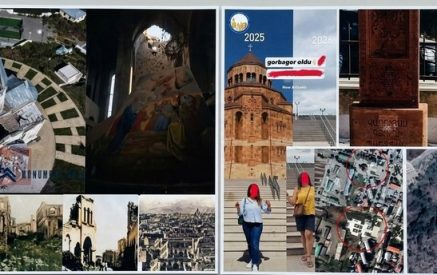
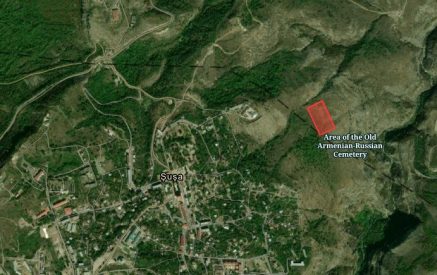
• In Shushi, the memorial dedicated to the victims of the Armenian Genocide, the Great Patriotic War, and the First Artsakh War has been completely destroyed. Azerbaijani authorities are currently constructing a museum, a mosque, and a public space on its site, demonstrating a deliberate policy aimed at the complete eradication of Armenian historical memory and the transformation of the historical and cultural landscape.
• In the village of Mets Tagher (Hadrut District), the bust of Marshal of Aviation Armenak Khanperyants and the MiG-17 aircraft monument have been destroyed.
• In the village of Azokh, three separate memorials commemorating those who perished in the Great Patriotic War, the victims of the Armenian Genocide, and the First Artsakh War have been destroyed. In addition, the memorial dedicated to those who lost their lives in both the Great Patriotic War and the Artsakh Liberation War has been desecrated and demolished.
• In the center of Berdzor, the memorial complex commemorating local residents who died during the Great Patriotic War has been completely destroyed.
• In Stepanakert, the bust of Admiral of the Fleet of the Soviet Union Ivan Isakov and the monument to Marshal of the Soviet Union Ivan (Hovhannes) Bagramyan have been destroyed.
• In Shushi, the monument to Ivan Tevosyan, Hero of Socialist Labour and an eminent Soviet statesman, has been dismantled.
• In the villages of Aterk, Vank, Yemishchan, Karintak, Khnatsakh, Avetaranots, as well as in the town of Martuni and numerous other settlements across Artsakh, memorials and commemorative complexes dedicated to those who perished in the Great Patriotic War and the Artsakh Liberation War have either been destroyed or severely damaged.
• In the Askeran District, an entire memorial complex has been completely destroyed.
The above list is far from exhaustive. Virtually every month, newly available satellite imagery documents additional acts of destruction targeting Armenian cultural heritage. The process of cultural genocide is continuing in real time, while its scale continues to expand.
The actions of Azerbaijan have long surpassed ordinary vandalism. They constitute a premeditated, systematic, and state-directed policy whose principal objective is the eradication of the historical memory of the Armenian people. What is being destroyed is not merely stone, monuments, or memorials; it is the collective memory of a people, the symbols of its national identity, and its spiritual connection to its historical homeland. This policy seeks to erase history in order to artificially substantiate the false narrative that Armenian civilization has never maintained a historical presence in Artsakh.
Such actions constitute a grave violation of international humanitarian law, including the provisions of the 1954 Hague Convention for the Protection of Cultural Property in the Event of Armed Conflict, the fundamental principles of UNESCO concerning the protection of cultural heritage, and universally recognized human rights standards. Moreover, they directly contradict the international obligations voluntarily undertaken by Azerbaijan through its membership in international organizations and its ratification of international treaties relating to the protection of cultural heritage.
The international community likewise bears a significant responsibility in the present situation. For many years, numerous statements, expressions of concern, and appeals have not been accompanied by effective mechanisms of international accountability or enforcement. Each act of destruction that has gone unanswered has effectively served as a signal of impunity, encouraging Azerbaijan to destroy additional monuments, desecrate further sacred sites, and eliminate yet more evidence of the Armenian historical presence. Impunity has thus become one of the principal factors enabling the continuation of the policy of cultural genocide.
Today, it is not only the cultural heritage of the Armenian people that is being destroyed in Artsakh. A unique component of the world’s cultural heritage and an irreplaceable layer of humanity’s historical memory are likewise under threat of disappearance. Should the international community continue to limit its response to declarations and expressions of concern alone, the world may soon witness the disappearance of an entire historical and cultural landscape, while the history of the region will be rewritten not through scholarly research and archival evidence, but by bulldozers.
Office of the Artsakh Cultural Heritage Ombudsperson,
State Service for the Protection of the Historic Environment of Artsakh (SNCO)
Media can quote materials of Aravot.am with hyperlink to the certain material quoted. The hyperlink should be placed on the first passage of the text.